From Concept to Packaging: Designing to Reduce, Recycle and Reuse.
When discussing sustainability in packaging, the first question we often ask ourselves is: which material should we use?
Glass, plastic, recycled materials, recyclable materials, bioplastics, wood, cork. We talk about weight, emissions, recycling, refill systems and green solutions. All of these are important topics, but perhaps there is an even more important question to ask before making these choices: how can we design packaging to minimize its environmental impact throughout its entire life cycle?
This is the question from which “Ambiente ALCEntro” was born.
“Ambiente ALCEntro” is a play on words—a slogan in Italian—that incorporates the name “ALCE” ; the standard, grammatically correct version would be “Ambiente al centro” (Environment at the center).
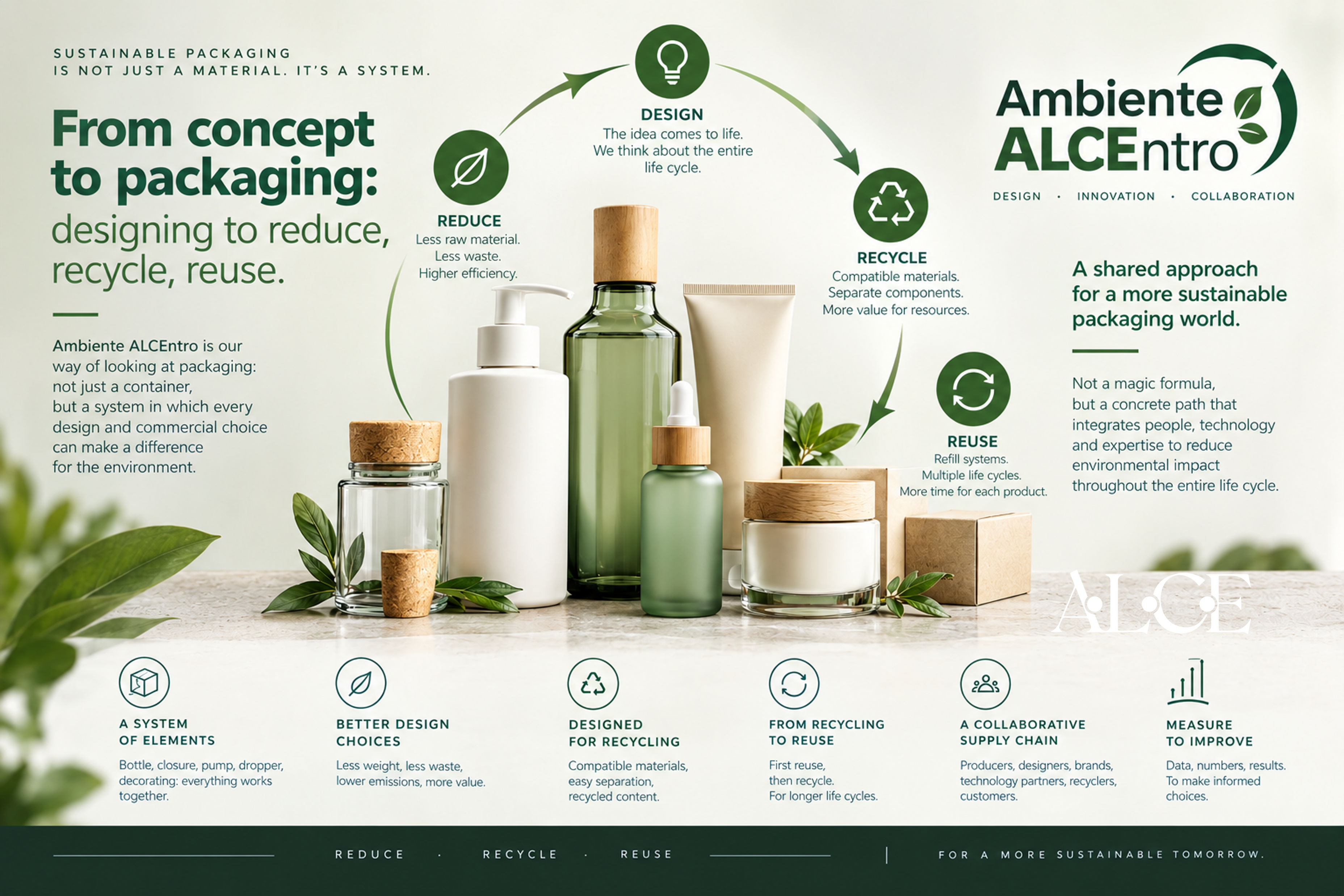
For us, this concept is not intended to be just another sustainability slogan, but rather a different way of looking at packaging: no longer simply as a container, but as a system in which every design and commercial decision can contribute to reducing environmental impact.
Because a bottle is not just a bottle. And a closure is not just a closure.
They are components that must work together, protect the product, ensure safety and functionality, communicate brand value and, at the same time, meet a new requirement: designing or proposing them with consideration for what happens once the product has been used up.
This is precisely where the concept of sustainability takes on a different perspective.
It is not simply a matter of choosing a “more sustainable” material, but of designing better. Reducing impact means first asking whether it is really necessary to use that amount of raw material, whether a bottle or closure can be made lighter without compromising performance, whether waste can be reduced, packaging optimised, transport volumes decreased and production processes made more efficient. It may seem like a small design adjustment, but when even a modest saving is multiplied across just a few thousand units, it can become an industrial and commercial decision with a significant impact.
Sustainability, therefore, does not begin when packaging is recycled. It starts much earlier: at the designer’s desk, but also within the commercial department. This is precisely the stage at which it becomes essential to move beyond a view of packaging based on individual components. Bottle, closure, pump, dropper, dispenser, capsule cover, decoration: each has its own function, but consumers see and use them as a single product.
That is why design should also start by considering the system as a whole. A closure can influence the choice of bottle material while dispensing system can determine how much product is actually used. A particular combination of materials can make end-of-life recovery more complex instead a design choice that may appear purely aesthetic can have consequences for production, transport or recycling.
Designing for sustainability therefore means designing the relationships between different components, not just the individual components themselves.
And this naturally leads to another topic: recycling.
From an industrial perspective, if packaging is considered not only in terms of when it is manufactured and used, but also what happens afterwards, this aspect sometimes takes a back seat from a commercial point of view.
What happens when the product runs out?
Can the different components be easily separated? Are the selected materials compatible with existing recovery systems? Is it possible to use recycled raw materials? Has the packaging been designed to facilitate material recovery wherever possible? Equally important, are customers made aware of more sustainable solutions?
These are increasingly important questions that lead us towards the concept of DesignXRecycle: designing with the possibility of turning materials back into resources in mind from the very beginning. But the real evolution of packaging could go even further.
It could move beyond the logic of “recycling after use” towards that of “reusing before recycling”. Consider, for example, the world of refill systems, as we have already explored in detail in one of our previous articles. A bottle designed to be reused several times completely changes the perspective. It is no longer an object necessarily intended for a single use cycle, but can become part of a longer-lasting system. Naturally, making this happen requires more than simply introducing a refill. And this is a fundamental point: a sustainable system must also be one that people are genuinely willing to use.
This approach also requires a cultural shift within companies and among their customers. Because taking sustainability seriously means learning to measure. Component weight. Raw material quantities. Waste. Energy. Transport. Durability. Recycled material content. Reusability. End of life.
There is no universal solution that works for every application.
Pharmaceutical packaging has different requirements from a cosmetic bottle. A system designed for fragrances or home fragrance diffusers has different characteristics from a container intended for the food industry. Sustainability cannot therefore be separated from function.
The real objective is to find the best possible balance between safety, performance, aesthetics, user experience, industrial feasibility and environmental impact. Equally important is advising customers and helping them understand that the same qualitative and technical results can be achieved through a more comprehensive approach to design.
This, for us, is precisely the meaning of “Ambiente ALCEntro“.
Not the search for a magic formula that makes environmental impact disappear, but the determination to move the point at which that impact is considered further and further upstream. Not when the product is already on the market, not when the packaging has already been manufactured, and not even when consumers have to dispose of it, but at the very moment the idea takes shape, whether it concerns a closure, a dropper, a bottle or a diffuser.
Because this is where we have the greatest opportunity to make a difference. And it is a journey that very few companies can undertake alone. It requires collaboration between glass manufacturers, closure manufacturers, packaging companies, designers, brands, technology manufacturers, recyclers and, of course, customers, who need to become increasingly aware of these issues. Last but certainly not least – perhaps the opposite is true – end consumers must also become increasingly aware of this approach, looking beyond price alone.
True circular economy takes shape when the entire supply chain stops thinking in terms of individual stages and begins to consider everything as one integrated system.
And perhaps this is precisely the most interesting challenge ahead of us.
Instead of simply asking ourselves “What is the most sustainable packaging?”, we should ask: “How can we design better packaging today for the world of tomorrow?”
Ambiente ALCEntro represents a commitment we have made to ourselves, because it is a journey built on design, innovation, collaboration, measurement, engagement and awareness-raising, both within our organisation and among our customers and end consumers.
A journey with an objective that is easy to express, but ambitious to achieve: reduce what we can reduce, recycle what we can recover, reuse what we can make last.