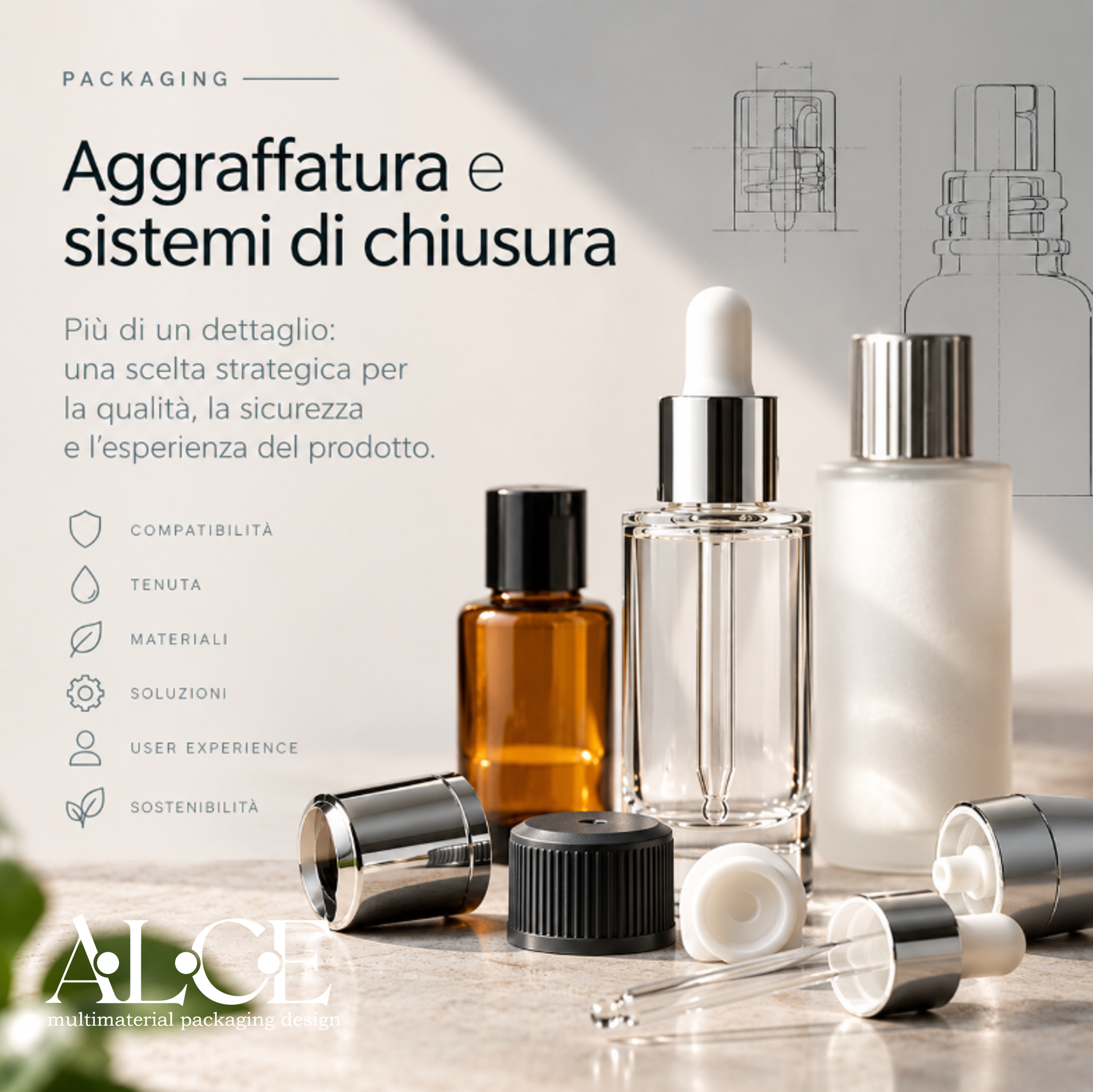
How to choose based on compatibility, seal integrity, materials, solutions, and user experience.
In packaging, a bottle’s closure is often perceived as a mere detail. In reality, it is one of the most important elements of the entire packaging system.
A closure must do more than simply “sit on” the bottle: it must be compatible with both the container and the formulation, guarantee a lasting seal, withstand filling and packaging processes, ensure intuitive use, and—increasingly—contribute to sustainability and the product’s perceived quality.
That is why discussing crimping and closure systems means discussing packaging design as a whole.
Crimping: a matter of precision
Crimping is a fastening method in which a ferrule is mechanically deformed around the bottle neck, locking the dispensing or closure system in place.
In the perfume industry and certain specialized applications, it is a well-established solution because it combines seal integrity, security, production efficiency, and aesthetic appeal.
However, crimping is not merely a mechanical operation.
The quality of the result depends on the interaction between:
• container neck geometry and dimensions;
• ferrule;
• sealing element;
• dispensing system;
• materials;
• machine parameters;
• dimensional tolerances;
• process conditions.
Even the slightest variation can affect clamping force, seal integrity, dispenser performance, or the final appearance and quality of the packaging.
In other words: no closure is truly effective unless it is designed in conjunction with the container/bottle. The initial question should not be “Which closure should I choose?” but rather “Which container-closure system is best suited to the product and its intended use?” It is a seemingly subtle, yet substantial, difference. In pharmaceutical packaging, for instance, the integrity of the closure system can be an essential requirement for protecting the product against contamination and external agents throughout its shelf life. In cosmetics, however, other factors come into play: dispensing method, frequency of use, ergonomics, premium perception, portability, and alignment with the product line’s positioning.
The process must therefore start with the application and lead to the solution—not the other way around.
1. Compatibility: the starting point
The first criterion is compatibility. This applies not only between the bottle and the closure but across the entire chain: formula + container + closure system + production process + end use.
The formulation may interact with certain materials or closure components. At the same time, the system must retain its properties during storage, transport, and use.
For this reason, compatibility should be verified by considering—where necessary—factors such as the chemical nature of the formula, viscosity, the presence of solvents, oils, surfactants, or specific active ingredients, contact time, storage conditions, sterilization methods (if applicable), and interactions with elastomers, polymers, metals, and coatings.
Compatibility is, therefore, not an attribute of a single component, but of the system as a whole.
2. Sealing performance: much more than just “preventing leaks“
A good closure must maintain product integrity over time. Sealing performance can address various needs: preventing leaks, limiting evaporation and permeation, or protecting against moisture and oxygen. It may also involve reducing contamination risks, maintaining formulation stability, and ensuring integrity during transport and handling.
In the pharmaceutical sector, the concept of Container Closure Integrity is mandatory ;sealing performance should not merely be verified at the end of the process but designed and validated from the very beginning.
3. Materials: choosing based on performance
Glass, PP, PE, PET, TPU, elastomers, aluminum, and composite materials—as well as wood, cork, and marble—may all come into play depending on the application. However, selecting a material based solely on aesthetics, cost, or availability is often too simplistic. One must simultaneously consider technical performance, compatibility, processability, weight, recyclability, and product perception.
Glass, for instance, can offer high perceived quality and protective barrier. Plastics, on the other hand, allow for advantages regarding lightness, strength, design flexibility, and—in certain configurations—system simplification.
Similarly, the closure itself can also become part of the sustainability strategy: reducing the number of materials, designing for recyclability, using recycled material where technically appropriate, and simplifying components are increasingly important factors.
Therefore, asking “What is the best material?” is certainly superseded by asking…“What is the most appropriate material for this application?”
4. Solution: standard or customized?
Another key step concerns the level of customization. A standard solution can offer significant advantages in terms of cost and availability, to name a few. Conversely, a custom solution becomes attractive when specific requirements are involved, offering clear benefits in terms of total flexibility regarding geometry, visual identity, dispensing mechanisms, and ergonomics. That said, it is important to understand when customization generates a genuine technical or commercial advantage.
A closure designed specifically for a given application can simultaneously enhance functionality, aesthetics, and product perception, but it must also be industrially viable.
5. User experience: the closure is the first point of interaction
There is another often-overlooked aspect: the user experience. After all, the closure is opened, closed, gripped, pressed, rotated, and looked at.
The closure is therefore one of the primary physical touchpoints between person and product. A positive user experience is essential—one that goes beyond mere physical contact—as other factors come into play, such as the perception of sturdiness or the alignment between the physical action and the function.
Returning to practical considerations: in both professional and consumer settings—where a product might be used many times a day or even while wearing gloves—ergonomics and simplicity become even more critical. In the premium cosmetics sector, however, the very act of opening and closing the product also contributes to the perception of quality.
The closure, then, is not merely a barrier; it is an integral part of the experience.
6. Crimping or screw system?
There is no universal answer; the choice must be guided by the application.
Crimping can be particularly attractive when a permanent seal or integration with specific dispensing systems is required. However, it requires careful design of the container neck, the closure ring, and the crimping parameters.
The screw closure—likely the oldest type of closure—is well-established and synonymous with reliability; it is often associated with ease of opening and resealing, as well as compatibility with numerous dispensing systems. The choice therefore depends on the product’s entire lifecycle, not just the packaging phase.
The real challenge lies in designing a system rather than simply selecting a component, marking a shift toward a systems engineering approach. The bottle, neck, closure, seal, dispenser, and process must all be viewed as parts of a single, integrated project.
This approach helps minimize the risk of incompatibility, improve process quality, and create packaging that is better aligned with the needs of both the product and the user.
This is also why packaging design is becoming increasingly interdisciplinary: materials, engineering, formulation, production, quality control, design, and user experience must all be integrated from the very early stages.
In primary packaging, the closure is not merely an accessory; it is a functional element that contributes to product protection, safety, perceived quality, production efficiency, and the user experience.