CAN GLASS BECOME PART OF MORE CIRCULAR PACKAGING?
When it comes to refills, the first association is often simple: “less disposable packaging, more reuse.”
But for those who design cosmetics and pharmaceutical packaging, the issue is much more complex. An effective refill system isn’t simply a matter of choosing a reusable bottle.
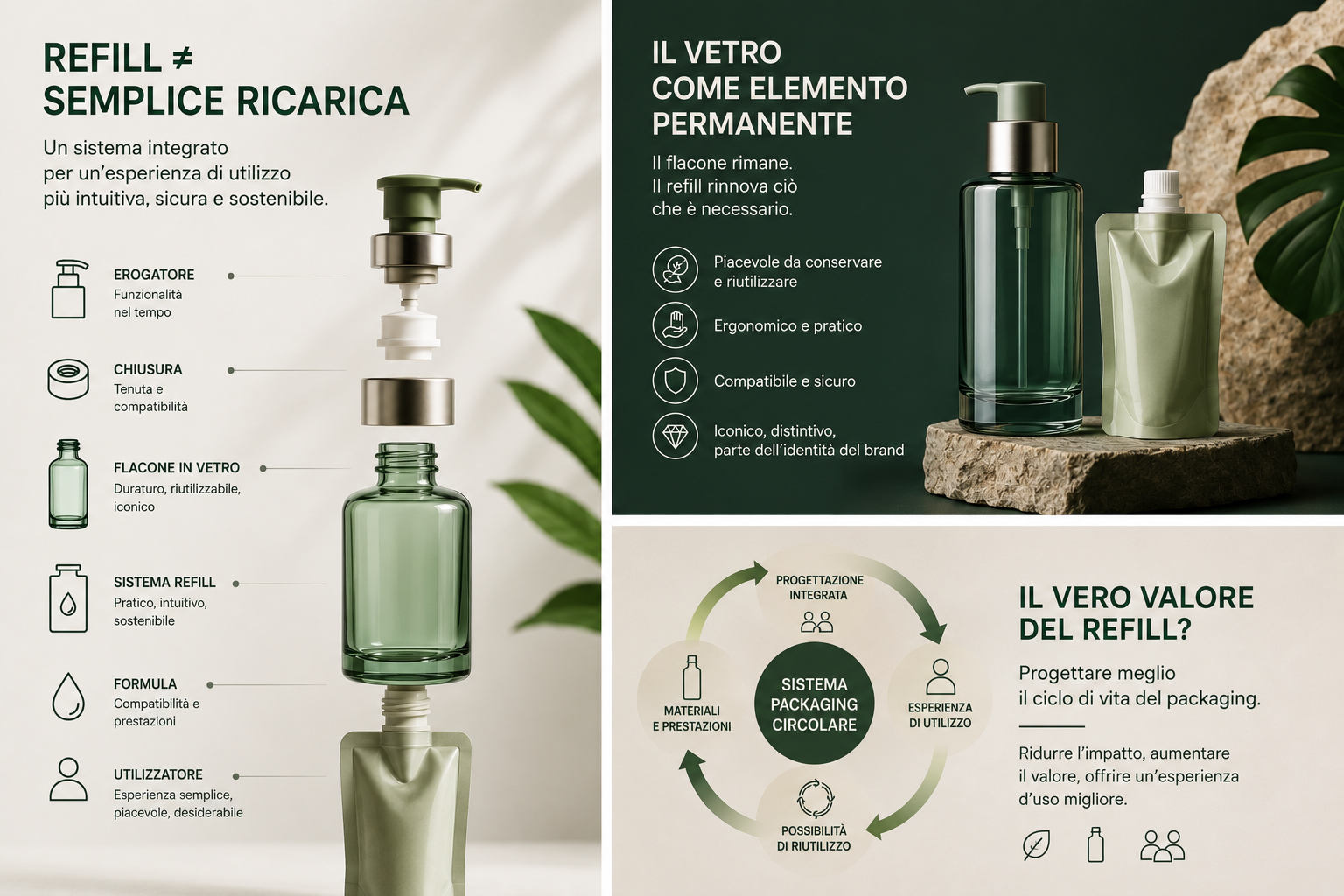
It arises when design, material, closure, dispensing system, formula, and user behavior are designed as a single system.
The role of glass.
Glass has a particularly interesting characteristic for this scenario: it can be perceived not as a simple container destined to be replaced, but as a permanent part of the product. A well-designed glass bottle can become the “main actor” that lasts over time, while the refill only replaces what is necessary to renew the contents.
And this is where design takes on a strategic role. A refillable bottle must be:
•pleasant to store and reuse
•ergonomic to use
•easy to clean and handle
•compatible with the product and the refill system
•designed together with the closure and dispenser
•distinctive enough to become part of the brand’s identity.
In other words: reuse must be designed, not simply declared.
Refill ≠ simple refill.
From a technical standpoint, the real leap is moving from the concept of “container” to the concept of a “system”.
Imagine, for example, a skincare bottle: glass bottle + pump + refill system + formula + refill method. Each element must interact with the others: compatibility between formula and materials remains fundamental. The closure must guarantee adequate performance. The dispenser must maintain its functionality over time. The refill system must be intuitive for the user. Equally important, the design must make the choice to reuse rather than replace natural.
This is even more true when packaging must meet stringent requirements for protection, safety, and precision, as in the pharmaceutical world.
The right question, therefore, isn’t: “Can we refill?”
The question should be: “Can we design a user experience in which refilling becomes the simplest, most intuitive, and most desirable choice?”
This is an important shift in perspective because a refill system truly works when the consumer doesn’t perceive it as a sacrifice. On the contrary, it must be perceived as an evolution of the product. The glass bottle can become an iconic and enduring element of the Brand. The refill can become/is the most practical way to continue using the product. The closure and dispensing system can become the elements that make this experience possible.
And this is where packaging engineering comes in.
For a company that develops bottles and closures, the future of refilling isn’t just about finding a new format. It’s about rethinking the interaction between container and closure.
Threads, opening systems, sealing, compatibility, dispensing, materials, tolerances, ergonomics, and ease of use all become design elements. All design elements that ALCE has considers, suggests, and addresses with its customers for more than 56 years.
And design must also work hand in hand with the technical side.
A refill may be sustainable on paper, but if it’s difficult to use, difficult to refill, or unpleasant to store, it’s unlikely to become a habit.
The true value of refills.
It’s not always easy to use less material, so the differentiator is to better design the packaging’s life cycle. And this opens up an interesting perspective for the industry: might the future no longer be “bottle + product,” but “packaging system + user experience + possibility of reuse,” or perhaps it already is?
Glass, in this scenario, doesn’t necessarily have to be considered the past of packaging. It can become one of the components of its future.
And you, when you develop a refill solution, where do you start from?
With the material?
With the bottle?
With the closure?
From the formula?
Or from the experience you want to offer the consumer?
The true refill project probably arises when all these variables are considered together, and at ALCE we have this deep knowledge and approach to design and support our customers in these new projects.